Second Silicon: Accelerating Post-Fab PCB Bring-Up
Archived project. Second Silicon is discontinued.
Problem
Once a PCB has been fabricated and assembled, teams need to find any issues with it and spin out new versions of the board before it is shipped to production. A board may power on while a peripheral refuses to enumerate. A power rail may be present while an MCU remains in reset. A sensor, camera, or communication bus may fail for reasons that are difficult to distinguish from firmware or configuration mistakes. Board bring-up spans hardware inspection, power, clocks, reset, interfaces, and firmware, so the evidence is spread across schematics, PCB files, firmware, logs, bench instruments, and engineer notes.
The result is a slow investigative loop: form a hypothesis, switch tools, take a measurement, reconstruct the relevant design context, and decide what to try next. This is especially painful for small hardware teams working with inherited designs, contractor output, or a new board revision.
The General Idea
The tagline for Second Silicon was a “Cursor for post-fab PCB bring-up”: a context-aware assistant for the work that begins after a board exists.
The idea was to start from a real KiCad or Altium project, let an engineer describe a symptom in plain language, connect that symptom to the relevant components and nets, incorporate measurements from tools like oscilloscopes, and preserve the investigation as a working thread.
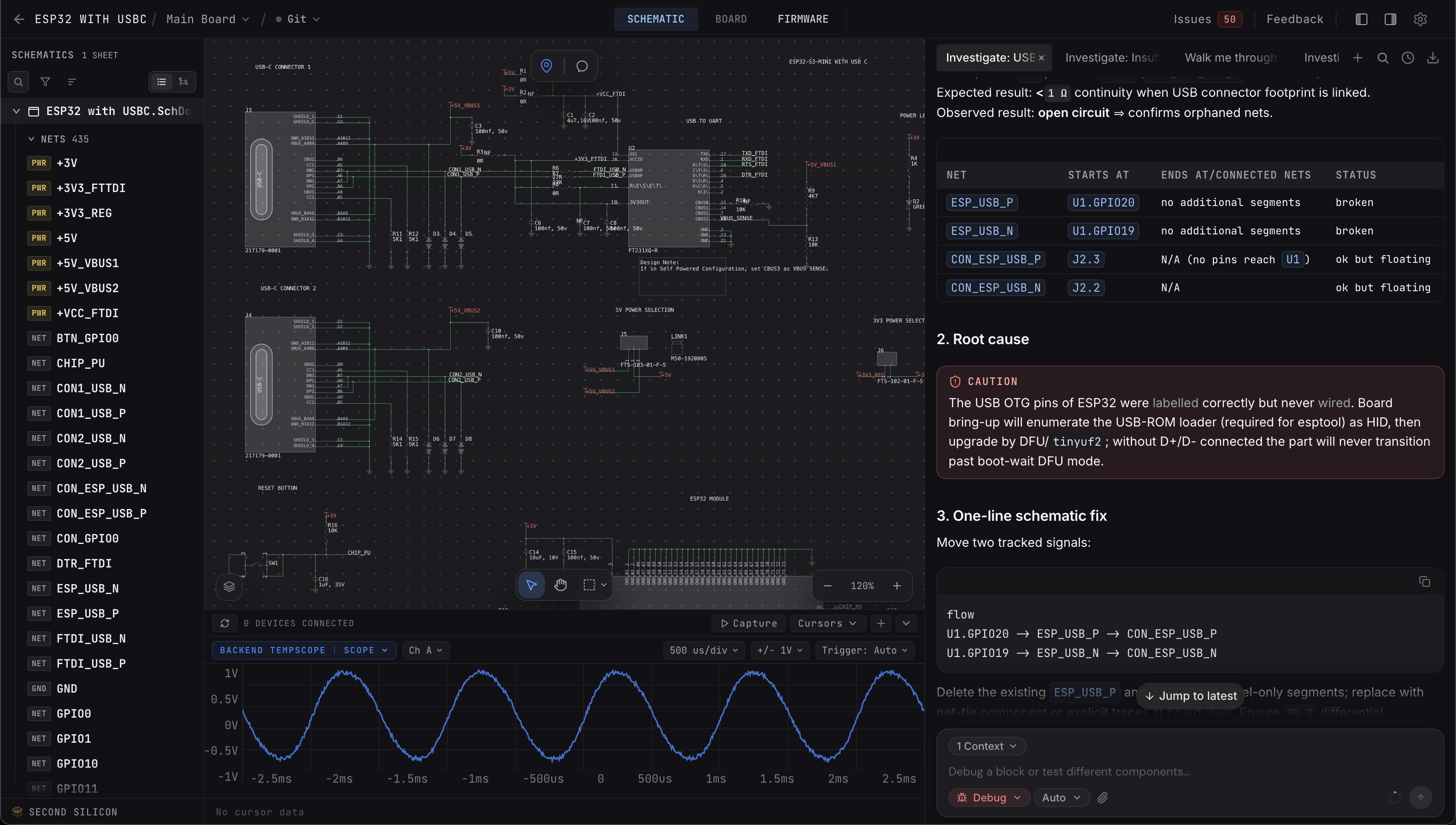 _The intended workspace keeps the schematic, measurements, and debugging reasoning in view together._
A Bring-Up Loop
Second Silicon was meant to support a simple, repeatable loop:
- Describe the observed symptom, such as “the board powers on but USB does not enumerate.”
- Relate the symptom to the design: relevant sheets, nets, components, and firmware behavior.
- Identify the next measurement that would distinguish between likely causes.
- Feed the result back into the investigation and refine the hypothesis.
- Keep the conclusion and next action attached to the board’s context.
For example, power being present does not prove that a USB interface is wired, configured, and communicating correctly. A useful assistant should help an engineer work through those possibilities without losing the connection between the bench result and the original design.
Collaboration
This project was co-developed with Vijay George in Spring–Summer 2026. My work covered hardware-interfacing software, oscilloscope integration with the live data stream, and KiCad and Altium schematic parsing.